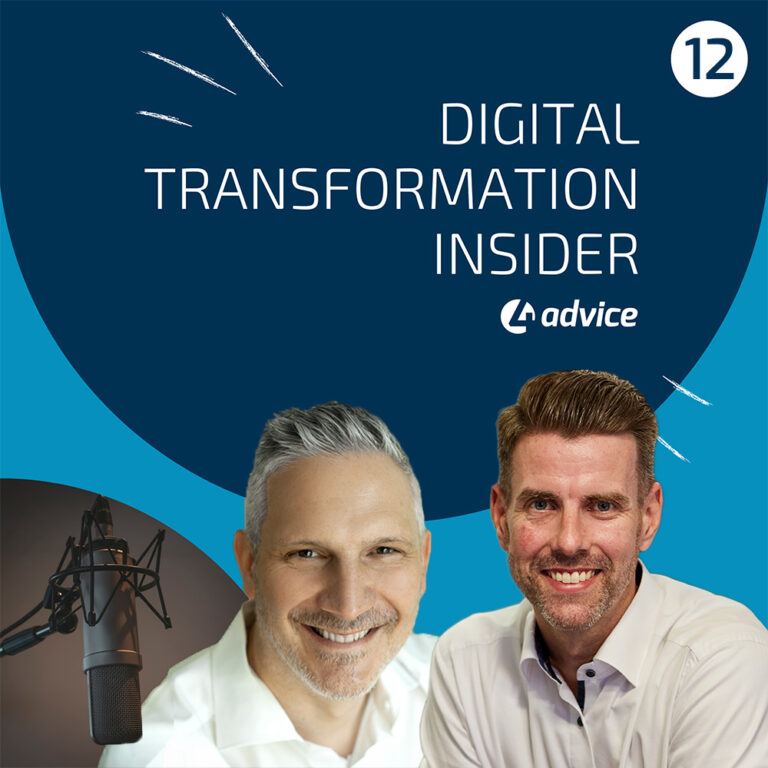

Thema: Digitale Transformation, Digital Transformation Insider mit Ralph Kaminski
Im Podcast „Digitale Transformation Insider“ spricht Simon mit Ralf Kaminski, IT-Leiter der Milchwerke „Mittelelbe“, über die Herausforderungen und Erfolgsfaktoren bei der digitalen Transformation. Besonders im Fokus stehen Change Management, der Einfluss von Künstlicher Intelligenz (KI) und die Bedeutung der Mitarbeiterakzeptanz.
Ralf Kaminski teilt seine Erfahrungen aus zahlreichen Digitalisierungsprojekten und hebt hervor, wie wichtig es ist, die Mitarbeiter von Anfang an in den Prozess einzubeziehen. Die Einführung neuer Technologien, wie Microsoft 365, erfordert nicht nur technologische, sondern vor allem kulturelle Anpassungen, um erfolgreich zu sein. Im Gespräch betont er die Bedeutung von KI im produzierenden Gewerbe und beschreibt die Chancen, aber auch die Risiken, die damit einhergehen.
Eine der größten Herausforderungen in der digitalen Transformation ist nicht die Technologie selbst, sondern die Mitarbeiter. Es reicht nicht aus, dass sie die neuen Tools nur verstehen – sie müssen diese auch als echte Arbeitserleichterung wahrnehmen und aktiv nutzen wollen. Digitization funktioniert nur, wenn alle mitziehen. Deshalb spielt Change management eine entscheidende Rolle. Ein gut durchdachtes Schulungsangebot und ein starkes Mentoring-Programm helfen dabei, die Akzeptanz der Mitarbeiter zu steigern und sie aktiv in den Prozess einzubinden.
Künstliche Intelligenz (KI) revolutioniert das produzierende Gewerbe und bietet enorme Chancen. Technologien wie Predictive Maintenance und digitale Zwillinge ermöglichen es Unternehmen, ihre Prozesse effizienter zu gestalten und Ausfälle proaktiv zu verhindern. Doch Vorsicht ist geboten: Es gilt, genau zu prüfen, welche Tools tatsächlich Mehrwert bieten und welche nur Hype sind. Der Einsatz von KI sollte gut durchdacht und passgenau auf die spezifischen Anforderungen des Unternehmens zugeschnitten sein.
Entdecke die Zukunft der digitalen Transformation mit unseren praxisnahen KI-Seminaren bei 4-advice. Lerne von ausgezeichneten Experten, wie du generative KI erfolgreich in deinem Unternehmen einführst und dadurch deine Produktivität nachhaltig steigerst.
Die digitale Welt ist extrem dynamisch – neue Technologien und Trends erscheinen nahezu täglich. Diese Schnelllebigkeit erfordert es, Entscheidungen sorgfältig abzuwägen, gleichzeitig aber flexibel zu bleiben. Es ist wichtig, immer am Puls der Zeit zu bleiben und Entwicklungen zu beobachten, ohne sich von jedem Trend mitreißen zu lassen. Besonders essenziell ist dabei die Zusammenarbeit zwischen IT und Fachabteilungen, um praxisnahe und nachhaltige Lösungen zu entwickeln.
Erfolgreiche digitale Transformationsprojekte benötigen folgendes:
In the Design Sprint, our Master Digital Management students developed solutions for marketing the digital service tool „Meine-Wartung“ from Niemann-Laes, a wholesaler for industrial supplies. Within just 4 days, they developed an expert-tested prototype under the, as always, sympathetic and knowledgeable guidance of our lecturers from 4-advice Digital Change & Innovation. It's always great to see how much we can achieve together in such a short space of time - a win-win-win situation for the university, students and industry partners. Keep up the good work and thanks to our students, the industry partners Maximilian Krause & Philipp Mitzscherlich and the lecturers Marcus Jansen and Simon Schoop, who successfully implement innovative and effective formats at Fresenius University of Applied Sciences every semester!
Simon has been teaching as a lecturer with a high level of professional expertise and great personal commitment for many years in the international master's program in Digital Management at the private Fresenius University of Applied Sciences in the Mediapark Cologne. The innovative teaching methods introduced by Simon and 4-advice, applying methodologies like the Google Design Sprint, add great practical value for our students. I have experienced 4-advice's methodological competence within their lectures „Digital Innovation“ and „Digital Transformation“. The Design Sprint is a great tool to reduce time-to-market to a bare minimum. That's why it's a very valuable method to develop new products, processes, organization and business models. Actually it can be used to tackle most types of challenges.”
I have come to know Simon and his 4-advice team as proven experts in change management and innovation. His approach of „playful change“, for example, is always breaking new and creative ground to achieve better results. One highlight is certainly the „Business Escape Rooms“, which I myself have experienced as very positive. As a specialist in project management, Simon and his team also support companies with organizational development teams with many years of experience and a great deal of intuition. Simon has absolute integrity, is always highly motivated and 100%ig reliable. He is true to his word! This is one of the reasons why I enjoy working with him so much - and why I recommend him.
The combination of theory and practice. We were able to apply what we learned in the training course directly to our day-to-day work and build a bridge directly to our job. The content is applicable to everyday work. I will integrate the methods but also the learned ways of thinking into my everyday work and act accordingly to successfully implement my changes. Change, change management will receive even more attention in the coming years and having already learned the relevant methods will help me personally to handle my tasks/changes in the best possible way. The training definitely fits in with the professional world and is not just theory.
The structured increase in knowledge led to aha-effects and often to questions as to why we hadn't thought of this ourselves. In any case, the DCM course enriches everyday project work and will lead to better change initiatives.
Thanks to the open and friendly lecturers, many practical points were addressed honestly and there was a good atmosphere in the course. What we learned will not just be put into practice in the future. It can already be felt in discussions and new projects. For the future, I will develop a standardized basic „substructure“ that will be individually adapted and/or expanded to the projects.
We will also need to address our most fundamental problems (communication, stable role allocation, rewards).
Last but not least, I'll probably be dreaming about agile working for a while ... great exchange, comprehensive consideration of the change, lots of practical tips, thinking outside the box, re-evaluation of our own activities in the past - most of the time we've already done a lot of things right, but never realized it
The mixture of change methods and their practical application. The documents, scripts, Excel templates and workbooks are absolutely practical for your own daily work in change projects. The module breakdown from the general understanding of digitalization to dealing with change is clearly structured. The trainers' distinct field of expertise in change management across different industries and organizations. The application of the methods for successful change in digitization that I have learned will help me a lot to achieve acceptance among stakeholders.
Through a mix of eLearning, teaching methods, case studies and live coaching, I have built up very valuable knowledge of digital change management, which I will also pass on to other project managers, especially young engineers.
The intensity and speed of change continues to increase rapidly - the digitalization skills taught by 4-advice are worth their weight in gold. Digitization as a rationalization factor will pick up speed rapidly in the coming years. There is still a considerable need for process digitization in many companies, especially in the medium-sized mechanical engineering sector, my core area. Training your own employees to become digital change managers is the basis for successful change and securing the company's future.
The content was very comprehensive and well-founded, the preparation of the content was very well structured and appealing. The speakers (Markus, Simon) presented the content in a very interesting way and supplemented it with practical examples. Questions from the participants were dealt with very well. The group composition was enriching due to the different backgrounds and the group work. I am constantly involved in change projects, so I can apply what I have learned very well, now with a much more sound background and more tools. Reason for recommendation: See above! However, you have to be aware of the disadvantage of a remote WB - the informal exchange of practical experience falls somewhat by the wayside. But all in all, a great training course!
The course was staffed by two extremely well-prepared trainers who not only guided the participants through the training in a competent and humorous manner, but also knew how to form a „harmonious learning group“ despite the virtual training sessions. In addition to an incredibly varied transfer of knowledge, there was never a shortage of fun and sharing of experiences!
I was able to apply almost all of the learning content during the training phase, be it in customer projects, in offers or in my daily work with colleagues.
Even in the private sphere, some of the content conveyed was of great benefit. Firstly, the „philosophy“ conveyed, what is behind „change“ and why it is worthwhile to deal intensively with direct and indirect influences and consequences. Secondly, because the training is more generalist in nature and therefore guarantees a wide range of professional and personal applications. Thirdly, because the combination of „firstly“ and „secondly“ generates maximum added value